


- AI search, answer engine optimisation, AI Overviews, Content Writing
Recent articles

our mailing list
How AI Decides Which Paragraph Becomes the Answer
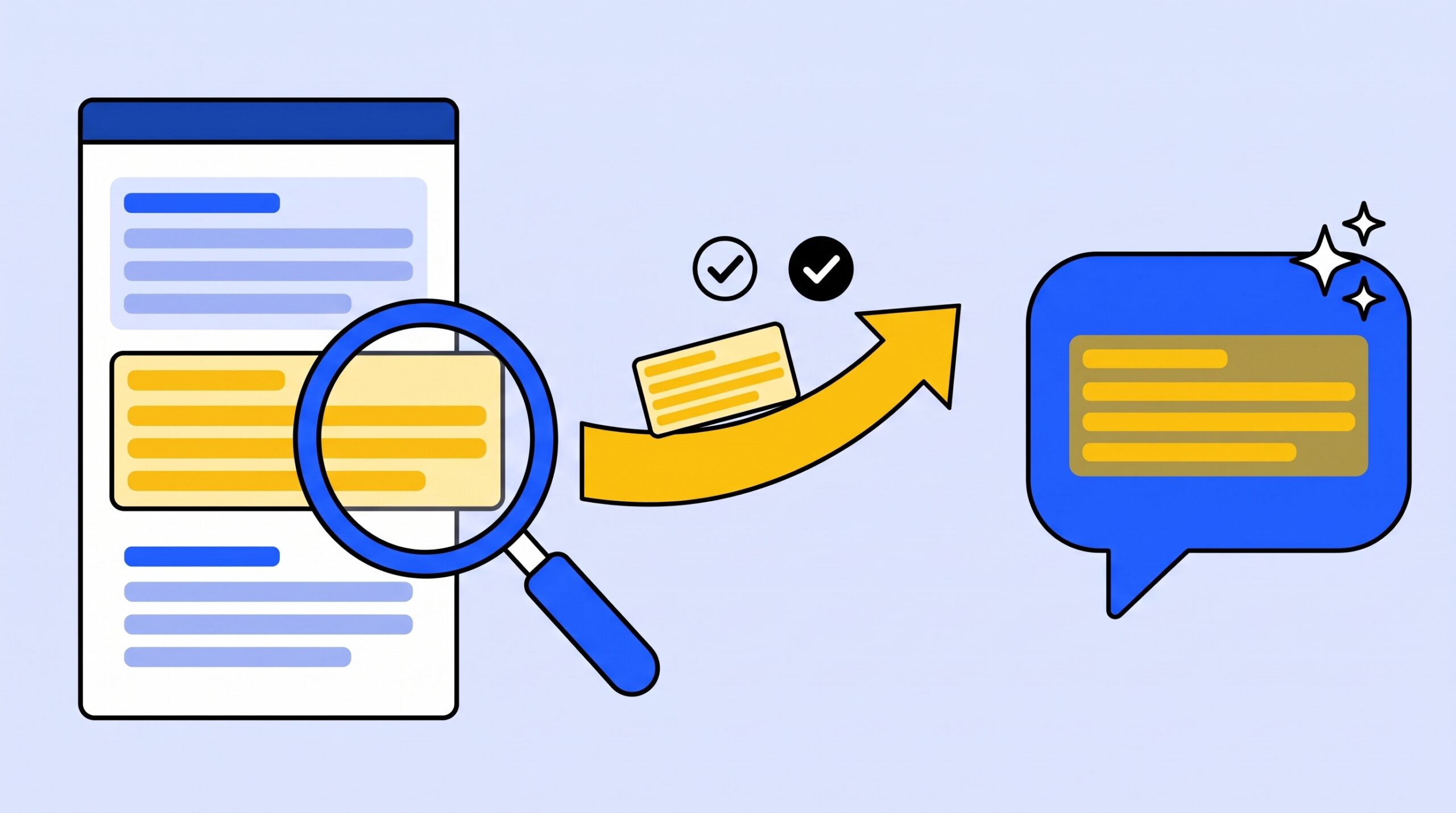
When someone asks ChatGPT or Google a question, the AI rarely reads your whole page and summarises it. It tends to hunt for the single best paragraph that answers the question and quote that. Understanding how AI finds answers on a webpage is the difference between being the source it trusts and the page it scrolls past. The good news: the patterns are fairly consistent across Google AI Overviews, ChatGPT, Gemini and Perplexity, and they’re within your control.
What AI is actually scanning for
How AI selects content comes down to one job: find the clearest, best-supported chunk of text that matches the question, then lift it into the answer.
It isn’t reading like a human. It’s scanning for:
- A heading that matches the question being asked
- A direct answer sitting right underneath that heading
- Language clear enough to quote out of context
- Evidence it can trust a stat, a source, a real example
Miss a few of those and your paragraph, however well written, becomes harder to use.
One paragraph, or several sources?
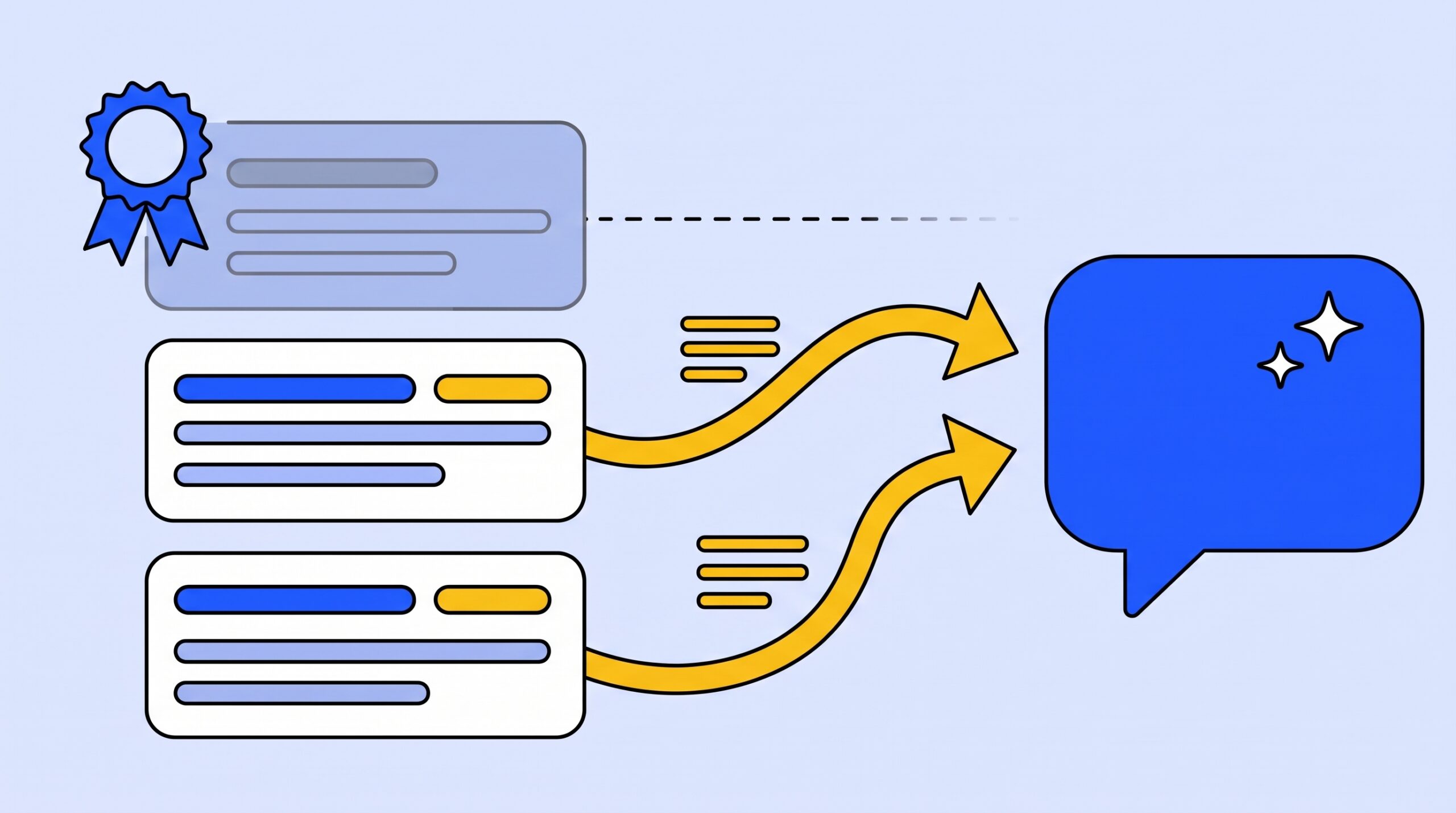
Here’s where most people guess wrong. How AI chooses sources usually isn’t “pick one winner” it stitches together strong passages from multiple pages into a single answer. Every section of your page is auditioning separately.
Pew Research Center put numbers to this: in its analysis of real search behaviour, 88% of AI summaries cited three or more sources, while only 1% relied on a single source.
The practical lesson: you don’t need to own the whole answer. You need one paragraph clear enough to earn its place in the mix.
What makes a paragraph get picked
The winning pattern for paragraph structure for AI search is close to mechanical: descriptive heading → direct answer → supporting evidence. That’s what we call answer-first content structure, and it’s the biggest lever we pull on client content.
Should the answer sit directly under the heading?
Almost always. Put the answer in the first sentence or two beneath the heading rather than three paragraphs down after a warm-up. AI systems, and impatient humans; tend to reward content that leads with the answer.
How specific should the heading be?
Very. Vague headings like “Overview” or “More Info” give the AI little to match against. Phrase the heading as the question a customer would actually ask, then make sure the opening line answers that specific question.
How long should the answer be?
As a practical writing guideline, aim to answer the core question within roughly 40–60 words before expanding into context and evidence. For reference, the typical AI summary Pew studied ran to about 67 words. If your answer can’t be lifted in a sentence or two, it’s probably too buried to be chosen.
Clear writing beats keyword repetition
Old-school passage ranking SEO tempts people to repeat a target phrase over and over. AI tends to do the opposite, rewarding clarity and evidence while treating repetitive keyword-stuffing as a low-quality signal.
This isn’t just opinion. Princeton’s GEO research, presented at KDD 2024, tested nine tactics across 10,000 queries and found that adding relevant statistics, credible quotes and citations from reliable sources improved visibility in AI answers by 30–40%. Improving fluency and readability alone delivered a 15–30% lift.
The SDM Answer-First Playbook
The process we use to write content for AI answers:
- Turn each heading into a question the way a customer would ask it.
- Answer it immediately underneath, in one or two plain sentences.
- Add one piece of proof — a stat, a source, or a real result.
- Keep every passage self-contained. No “as we mentioned above.”
- Break multi-part questions into their own sub-headings so each answer stays clean.
Deep Insight: the self-containment rule nobody talks about
Everyone repeats “front-load your answer.” The overlooked rule is self-containment. Because AI lifts a paragraph out of its surroundings, any sentence leaning on “as covered earlier” or “see the section above” loses its meaning the moment it’s extracted.
The paragraphs that consistently become content cited by AI read like standalone answer cards — they make complete sense on their own, with zero context. Write every key passage as if it will be quoted in isolation, because that’s often exactly what happens.
Your Content Is Well-Written. But Is It Built to Be Quoted?
Most Australian businesses are still writing for readers who scroll, when the gatekeeper is increasingly an AI deciding in a split second which paragraph becomes the answer. Beautiful, keyword-rich content that buries its point gets read by no one, because it never makes it into the response the customer actually sees.
You’ve read this article. You know where the gap is.
At Sydney Digital Marketing, we help Australian businesses restructure their content so AI engines can find it, trust it and quote it — turning pages that get ignored into sources that get cited.
Book your free strategy session
One session. A clear picture of why your content isn’t being picked up. A practical plan for what changes next.
Article by
Simon Gould
CEO / Founder / Dad
Founder and leader, Simon established SDM back in 2012. Since then, he has helped 150 clients (and counting) to achieve their digital goals.[…]
