




Recent articles




our mailing list
DUDA Vs WordPress
Introduction
Think of your website as your business’s brick-and-mortar store, but online. Just like a physical store, it needs to attract attention, guide visitors through the experience, and leave them confident they’re in the right place.
Choosing the right platform is like picking the perfect location and layout for that store. Get it wrong and you’re left with headaches, an outdated website and missed opportunities. Get it right, and your website becomes a powerful tool that works for you 24/7.
Our development team has tested both stacks extensively, and the difference in day-to-day management is night and day. Over time, we’ve seen what scales, what breaks, and what drives measurable business results. This perspective shapes our comparison below.
In 2025, Duda and WordPress stood out as two of the most popular yet fundamentally different platforms. Duda positions itself as a fast, intuitive, all-in-one solution for agencies and small businesses, while WordPress has long been the heavyweight champion of customisation and control.
In this comparison, we’ll compare both platforms across the factors that matter most: customisation, ease of use, performance, SEO, and pricing. This will help you decide which is the right fit for your goals.
This blog will help you compare Duda vs WordPress, two of the most popular platforms often discussed as the best WordPress alternatives in 2025.
Customisation and Design Flexibility
When it comes to flexibility, the WordPress editor is unrivalled. With thousands of plugins and themes, plus the ability to modify code, it offers virtually limitless design possibilities. For developers and advanced users, this level of control is ideal for building complex, highly personalised sites that can scale with unique business needs.
Duda, on the other hand, takes a different path. The Duda site editor with drag-and-drop functionality makes professional websites quick and seamless.
In our experience, Duda’s design environment drastically reduces production hours for multi-site builds. We’ve delivered award-winning full client rebrands in under half the time it typically takes with WordPress without sacrificing on quality.
By limiting some coding options, Duda prioritises consistency and simplicity. This makes it especially attractive for agencies managing multiple client sites or small business owners who want polished results without the technical headaches.
Performance and Security
In the Duda vs WordPress SEO debate, performance also plays a role in rankings.
Duda wins points for being optimised out of the box. Features like server-side rendering, AWS cloud hosting, and automatic image compression mean load times stay consistently fast, and no tweaking is required. Its managed platform also takes care of the heavy lifting on security, reducing exposure to common vulnerabilities.
Across multiple SDM client migrations, we’ve consistently seen Duda outperform WordPress on mobile load times and Google Core Web Vitals. With WordPress, performance is far more variable. A lean site on solid hosting can be lightning quick, but stack on too many plugins or cut corners on hosting, and performance takes a hit. The same goes for security: its open-source freedom is powerful, but it comes with the constant responsibility of updates, patches, and plugin maintenance.
From an agency operations standpoint, Duda’s managed hosting has nearly eliminated those late-night ‘site down’ alerts that used to plague WordPress clients.
SEO Capabilities
When comparing Duda vs WordPress SEO, the difference comes down to built-in simplicity versus plugin-powered control.
For SEO, Duda keeps things simple yet effective. Integrated tools cover essentials like Core Web Vitals optimisation, XML sitemaps, and schema markup. Non-experts can manage their site’s search visibility without wading through endless technical settings.
We’ve also seen Duda sites hold steady in search rankings even through algorithm updates, likely due to consistent technical SEO hygiene baked into the platform. Meanwhile, WordPress sites still require plugin management and manual audits to maintain parity.
WordPress, however, is the SEO playground. With plugins like Yoast and Rank Math, users gain granular control over every element of optimisation from metadata and breadcrumbs to advanced schema configurations. But that power comes at a cost: time, setup, and ongoing management. If you’re willing to invest the effort, WordPress can deliver unmatched SEO depth.
Pricing Models
When it comes to cost, Duda keeps it simple. Duda pricing runs on a subscription pricing model starting at around $25 and scaling up to $199 per month. That fee bundles in hosting, security, and built-in tools a predictable, all-in-one package agencies and SMBs can budget for without the nickel-and-diming of third-party extras.
For our clients, that predictability matters. Duda pricing translates to clear, transparent billing for clients, no surprise plugin renewals or developer maintenance charges down the track.
WordPress plays a different game. WordPress website pricing swings wildly, from under $10/month to thousands per year for managed hosting. That flexibility is part of the appeal, you can start lean and scale, but it also means your budget is only as controlled as your plugin habits and hosting choices.
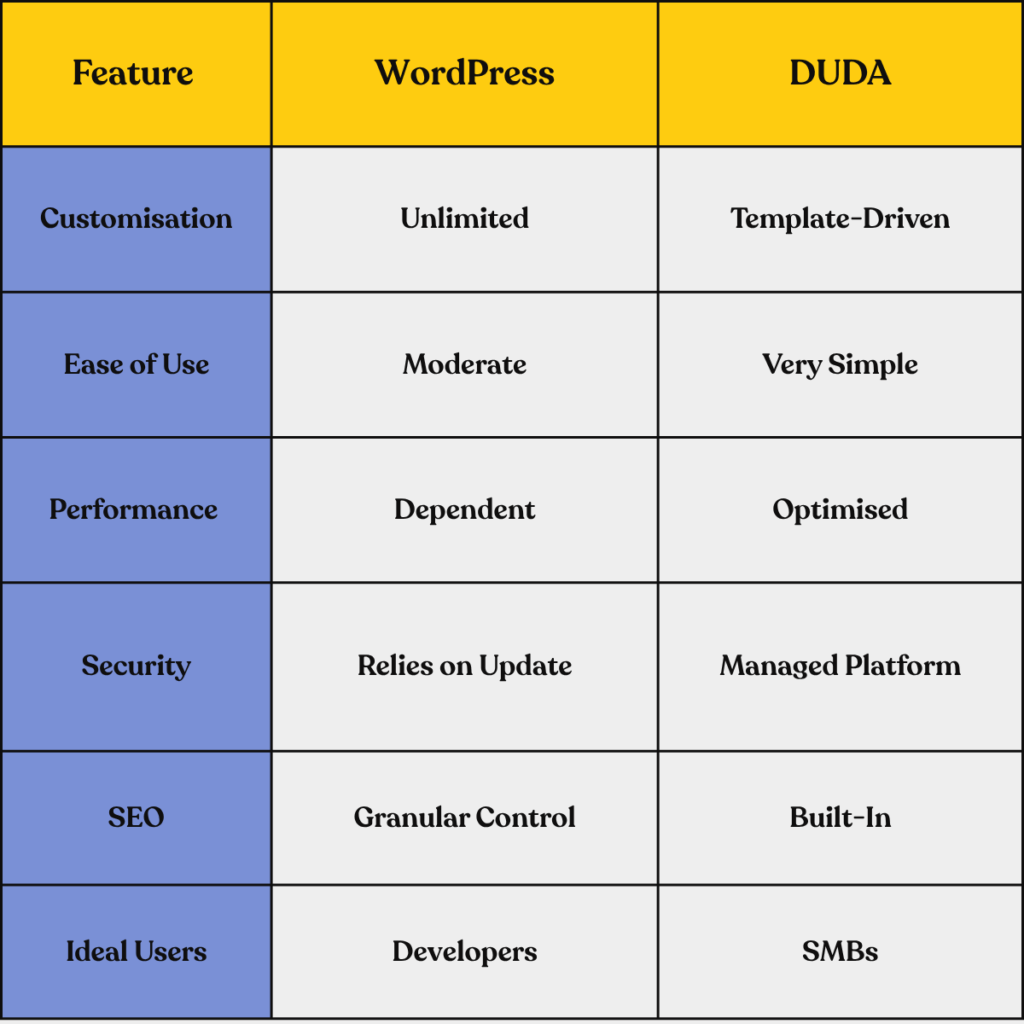
Side-by-Side Comparison Table
Who Should Choose Which?
So, which camp do you belong to?
If you’re deciding between Duda or WordPress, it depends on whether you prioritise simplicity or customisation.
- Choose WordPress if… you’re a developer, power user, or a business with complex, evolving needs. You’ll thrive on the flexibility, the vast plugin ecosystem, and the freedom to bend the platform to your will. But be prepared: that freedom comes with the responsibility of managing hosting, updates, and security.
- Choose Duda if… you want a professional website without the technical legwork. SMBs, agencies, and non-technical entrepreneurs will appreciate the simplicity, speed, and all-in-one structure. It’s designed to let you focus on running your business, not patching plugins at midnight.
In short, WordPress is the toolbox; Duda is the turnkey solution. Your decision depends on whether you want to build your own workshop or open the door and get to work.
Conclusion
When you stack Duda and WordPress side by side, the trade-offs are clear. WordPress is the veteran powerhouse, unmatched in customisation, endlessly extendable, and perfect for those who want to mould every detail of their digital presence. But that power requires time, technical know-how, and often a developer on speed dial.
Duda, by contrast, is the streamlined specialist, quick to deploy, easy to manage, and built for agencies and SMBs that value speed and polish over deep control. It may not offer the same infinite flexibility, but it delivers consistency, security, and performance without the headaches.
There’s no universal winner here. The right choice depends on your goals, resources, and appetite for technical complexity. If you crave control, WordPress is your workshop. If you want efficiency, Duda is your ready-made engine. Either way, your website in 2026 isn’t just a platform; it’s the foundation of your growth.

Article by
Simon Gould
CEO / Founder / Dad
Founder and leader, Simon established SDM back in 2012. Since then, he has helped 150 clients (and counting) to achieve their digital goals.[…]