





- Conversational AI, Voice Search Optimisation, Conversational Artificial Intelligence, Conversational AI Agents
Recent articles



our mailing list
Conversations, Not Queries: Content for Agents, Assistants & Voice
Think back to early 2020. Most people were paying attention to the metrics they knew: rankings, clicks, and session times. Then, almost overnight, the world rearranged itself.
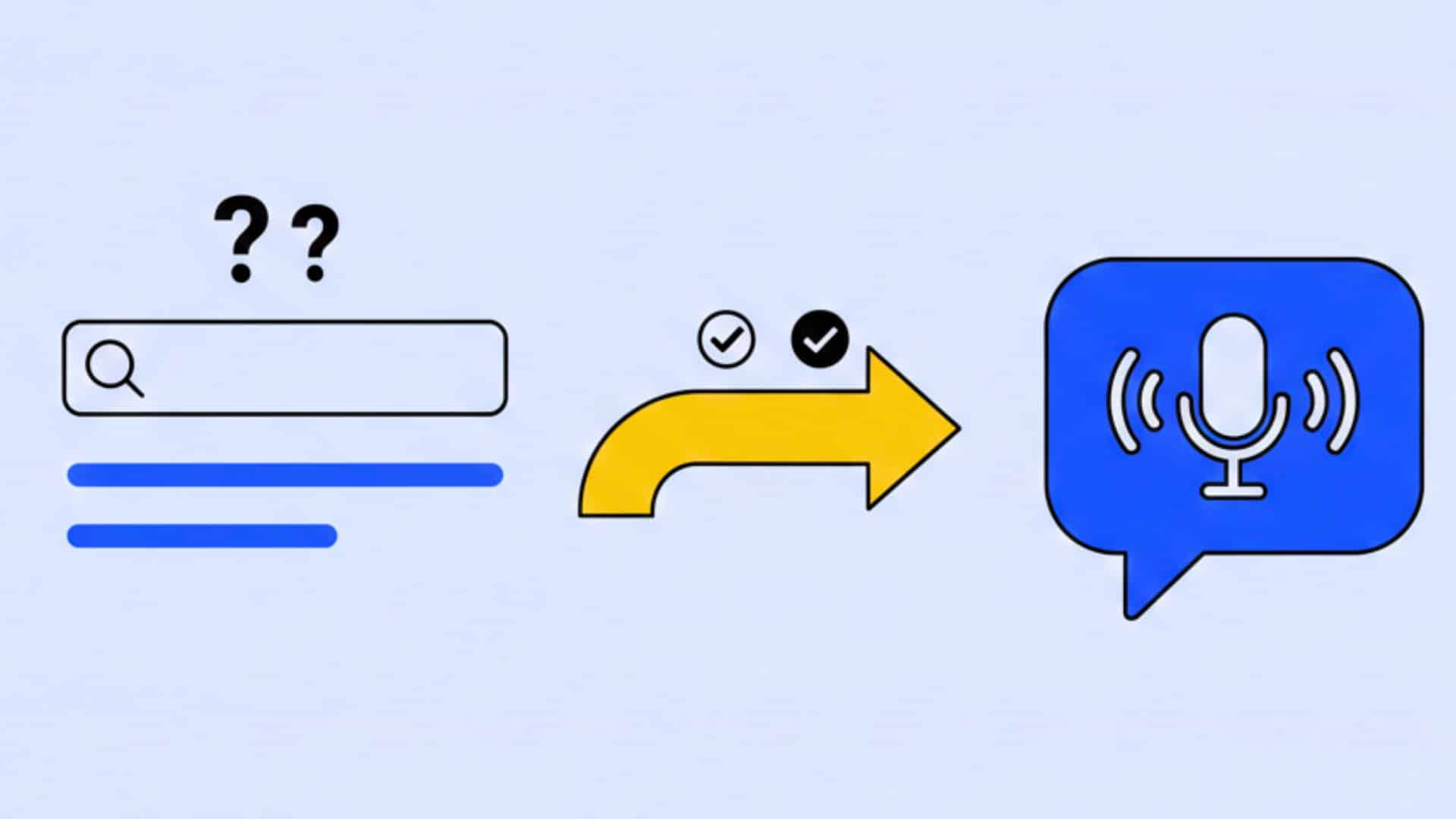
The era of “10 blue links” is evolving; we have entered the age of the Answer Engine. For over two decades, Digital Marketing was a visual game: ranking on a screen, enticing a click, and capturing a session.
But as Conversational AI agents and Voice Search Optimisation become the primary interfaces for discovery, your website’s role is shifting. It is not disappearing; rather, it is becoming the definitive Data Source.
In this Zero-UI landscape, users interact through natural Intent rather than screens. Your brand’s survival now depends on a fundamental shift.
You must make your website AI-Legible, authoritative, and quotable. This ensures autonomous agents can find, trust, and surface your data
What Is Conversational AI?
Conversational AI refers to artificial intelligence systems, including chatbots, voice assistants, and AI agents, that interpret natural language and respond in real time. Unlike traditional search engines that simply match keywords to pages, Conversational Artificial Intelligence understands the human Intent behind a question and synthesises a direct, helpful response.
For businesses, this means your content is no longer just being “read” by people; it is being “processed” by machines to provide instant answers to your customers.
Key Takeaways:
From Clicks To Citations: Stop measuring success by website visits alone. In 2026, the goal is “Assistant Discovery.” You want AI assistants to choose your data as their primary source.
The A-C-E Rule: Lead every section with a direct Answer. Follow with Context and back it with Evidence. This removes the guesswork for Conversational AI agents.
Ditch The Fluff: “Agent-Friendly” content prioritises fact-checked reliability over creative prose. If an assistant can’t verify your facts quickly, it will skip you to avoid hallucination risks.
Speak Human Structure For Bots: Use natural, long-tail conversational phrases that people say out loud. Wrap them in technical structures like FAQ Schema and H1 > H2 > H3 hierarchies.
The Trust Factor: Consistently refresh your data. Add a unique human POV through case studies and first-hand lessons to prove you aren’t just a generic AI bot.
Why Your Website Is More Important Than Ever
There is a common misconception that websites are becoming obsolete, but the opposite is true. The website is the bedrock of this new era. If a site doesn’t exist, isn’t trusted, or can’t be crawled, it won’t be included in the conversation at all. It remains the critical anchor for brand trust, service enquiries, and the transactions that keep a business running.
To Optimise Content For Voice Search, the goal is no longer just chasing keywords; it is building for Agentic Retrieval. This requires providing the high-fidelity evidence that AI systems need to feel confident enough to recommend a service.
What Are Conversational AI Agents?
Conversational AI Agents are advanced systems (like Gemini, ChatGPT, or Claude) that don’t just find information, they use it to complete tasks. Whether it’s a marketing manager asking a voice assistant to “find the best CRM for a startup” or a traveller asking for a curated itinerary, these agents rely on your website as their definitive reference material.
They don’t just provide a list of links; they provide a result. Research shows that traditional search engine volume will drop by 25%, meaning your content must be structured for these agents to ensure your brand remains at the forefront of the conversation.
This shift is happening now. For a brand, it means the website must move from being a digital brochure to becoming a verified Data Source. If content is structured for Conversational AI Agents, it ensures that when an agent is asked for the “best” in an industry, that brand is the one it trusts, cites, and defends.
How To Optimise Content For Voice Search (2026 Guide)
The transition from traditional typing to verbal enquiry requires a complete overhaul of how information is presented. When a user asks a question out loud, they are not looking for a list of possibilities; they are looking for a definitive solution. To successfully Optimise Content For Voice Search, a brand must move away from fragmented keywords and focus on the natural rhythm of human dialogue.
What Is Conversational Search Optimisation?
Conversational Search Optimisation is the process of structuring digital content to mirror the natural, multi-step dialogue of human speech. Unlike traditional SEO, which targets isolated keywords, this approach focuses on Answer Intent, ensuring that when a user asks a complex question, an AI assistant can instantly synthesise your data into a clear, spoken response.
The Blueprint For Assistant Discovery
In 2026, Voice Search Optimisation is no longer a luxury; it is a technical requirement for visibility. Success in this area depends on creating “modular” content that can be easily extracted and read aloud by an assistant. The following six steps form the definitive framework for Assistant Discovery:
- Use Natural, Full-Sentence Questions: Target long-tail queries that mirror how humans actually speak in conversation (e.g., “What is the best CRM for a startup?”).
- Lead with Direct Answers (A-C-E): Ensure every section leads with a direct Answer, followed by Context, and backed by Evidence to satisfy Answer Intent.
- Implement FAQ Schema: Use this digital translator to identify your text as a “definitive fact” for the assistant.
- Use Speakable Markup: Explicitly tag the 2-3 sentences on a page that are best suited for audio playback by a voice assistant.
- Micro-Chunk Content: Break all text into 1-4 line blocks to allow for seamless Agentic Retrieval and extraction.
- Add Pros/Cons and Step Lists: Provide the semantic logic that Conversational AI needs to confidently recommend your services over a competitor.
This six-step framework isn’t just a technical exercise; it represents a fundamental shift in how search engines operate.
To understand why Assistant Discovery now outweighs traditional rankings, we must compare the mechanics of the old ‘Search’ world against the new ‘Conversational’ era:
| Feature | Traditional Search | Conversational Search |
|---|---|---|
| User Input | Fragmented keyword phrases | Full, spoken natural questions |
| Output Style | A list of "10 Blue Links" | One synthesised , direct answer |
| Primary Metric | Click-Through Rate (CTR) | Assistant Discovery & Citations |
| Engine Logic | Page ranking & indexed URLs | Answer extraction & data trust |
| Technical Focus | Metadata for human clicks | Schema for Agentic Retrieval |
Best Conversational AI Tools (By Category)
To maintain visibility in a Zero-UI landscape, businesses must familiarise themselves with the ecosystem of tools currently shaping the Answer Engine era. These tools are the gatekeepers between a brand’s data and the end user.
- Voice Assistants (Alexa, Google Assistant, Siri): The primary interfaces for hands-free discovery. These rely heavily on Voice Search Optimisation and schema-rich data to provide verbal recommendations.
- Chat Assistants (ChatGPT, Gemini, Claude): The “Logic Engines” of 2026. These systems synthesise website content to provide deep, conversational answers and are the primary targets for Agentic Retrieval.
- Conversational Analytics Tools: Platforms designed to track how Conversational AI Agents are interacting with a website, moving beyond traditional click-through rates to measure citation frequency.
- Schema & Structured Data Validators: Essential technical tools used to ensure that FAQ Schema and Speakable markup are error-free, allowing for seamless interpretation by AI crawlers.
What is Content for AI Agents?
Content for AI Agents is information architected as structured, self-contained knowledge blocks that allow digital assistants to interpret, verify, and surface data with Agentic Certainty. By prioritising direct answers and technical Schema, this content ensures a brand is used as a definitive reference rather than being buried in a traditional narrative.
If an agent cannot parse your data hierarchy or verify your claims, your brand effectively loses its visibility in the conversational layer, as these systems prioritise clarity and structure over creative prose.
For example, utilising Structured Formatting such as FAQ blocks with schema markup increases the likelihood of being cited in an AI summary. Following a strict H1 > H2 > H3 hierarchy and using tables for comparisons provides the semantic logic that AI systems like Google’s Gemini and ChatGPT require to confidently recommend a product or service.
The Strategic Perspective: Your Website as Training Data
As a Business Owner or Marketing Manager, you must view your digital presence as a repository for “Answer Intent”. If your content is vague, buried in fluff, or lacks Structured Formatting, agents will skip it to avoid the risk of hallucination. To win in 2026, you aren’t just writing for people; you are providing the high-fidelity data that powers the personal assistants of your future customers.
How To Optimise For Conversational Search: A Step-By-Step Framework
Optimising for a conversation is fundamentally different from optimising for a keyword. It requires a shift from “marketing to a screen” to “providing a solution for a listener.” To capture visibility in Conversational Search, a brand must align its content with the way people naturally seek help.
In 2026, the goal is to become the “Source Of Truth” that an assistant feels safe enough to quote. This doesn’t happen by accident; it requires a deliberate, technical, and human-centric approach.
The 4-Step Framework For Assistant Discovery
Step 1: Identify Intent Clusters, Not Single Keywords – Modern search behaviour has moved away from shorthand fragments. Instead of targeting “Sydney plumber,” focus on Intent clusters like “Who is the best emergency plumber in Sydney available on a Sunday?” Use tools to map out the full, natural questions your audience is asking their devices.
Step 2: Implement “Answer-First” Page Architecture – Stop “burying the lead” in the third paragraph. Every major section should lead with a direct, 2-3 sentence Answer. This “Answer-First” structure provides the Conversational AI with an immediate snippet to extract, followed by the context and evidence it needs to verify the claim.
Step 3: Build for Machine-Readability and Extraction – Structure is the only way to prove authority to a machine. Use a strict H1 > H2 > H3 hierarchy and break long “walls of text” into Micro-Chunks (1-4 line blocks). This allows an agent to “scrape” specific passages and read them aloud without losing the intended meaning.
Step 4: Feed the Knowledge Graph with Schema – Metadata is the translator between your brand and the assistant. Implement FAQ Schema and Speakable markup to tell the AI exactly which parts of your page are definitive facts. By explicitly defining the relationships between your brand, your services, and common queries, you build a digital Knowledge Graph that assistants can rely on.
This technical layer is a cornerstone of AI SEO, ensuring that by explicitly defining the relationships between your brand, your services, and common queries, you build a digital Knowledge Graph that assistants can rely on.
Proving You Are A Reliable Source
To build lasting topical authority, brands must align their content with E-E-A-T principles, ensuring every piece of information is backed by first-hand experience and verifiable data that an AI agent can cross-reference with confidence.
High-quality, AI-ready content must demonstrate real-world Experience and Expertise to avoid being filtered out as “generic AI fluff”.
AI agents prioritise “Answer Certainty”. If your content lacks credible sources, case studies, or original insights, the agent perceives a “hallucination risk” and will skip your brand in favour of a more authoritative entity.
For instance, refreshing data examples quarterly and including real screenshots or data points provides the high-fidelity evidence that AI systems like Perplexity or Google’s Gemini use to validate their conversational responses.
The Human-in-the-Loop: Why Real Perspective Wins
AI amplifies real expertise; it cannot replace it. To diagnose visibility issues in AI chat and agent-driven search results, look at your ‘human signal’. If you are simply echoing what is already on the web, you offer no new value to an agent’s knowledge graph.
This is where Content Humanisation becomes a competitive advantage; by including first-hand lessons and real observations that an LLM cannot synthesise, you prove your brand is a trusted, living source of information.
- Add Human POV: Include first-hand lessons and real observations that an LLM cannot synthesise on its own.
- Cite Your Sources: Back every major claim with frameworks or data from industry leaders to build Entity Mapping between your brand and established truths.
- Be Accuracy-First: Fact-check every line to protect your brand’s “Trust” score; one hallucinated stat can lead to an agent blacklisting your domain.
Why Your Content is Missing from AI Chat Results
To diagnose visibility issues in AI chat and agent-driven search results, you need to look for “friction points” like buried answers, a lack of Technical SEO Foundations, or missing E-E-A-T Alignment. Visibility in a “Zero-UI” world is all about Agentic Certainty. If an assistant cannot verify your facts or navigate your content’s structure, your brand effectively disappears from the conversation.
The Structural Foundation: Metadata And Structure
For an AI agent, a website’s visual design is secondary to its data hierarchy. If the Semantic Hierarchy is broken or metadata is missing, the assistant perceives a Hallucination Risk and will likely skip the brand in favour of a more structured competitor.
The following technical components provide the Agentic Certainty required for an assistant to interpret, verify, and read your content aloud:
| Component | Role in Assistant Discovery |
|---|---|
| FAQ Schema | Translates text into "Definitive Facts" for chat. |
| Speakable Markup | Identifies the specific snippets to be read aloud. |
| Semantic Hierarchy | Uses H1-H3 tags to provide a logical knowledge map. |
| Micro-Chunking | Breaks text into 1-4 line blocks for easy extraction. |
Best Practices for AI Voice Assistants Content Markup
To secure a spot in voice responses, you must transition from “long-form obscurity” to Structured Formatting, where key information is modular, self-contained, and explicitly tagged with Schema.org markup for machine retrieval. This technical foundation allows AI agents to parse your data hierarchy and identify your brand as a definitive source of truth.
Structured Formatting for AI Comprehension
AI systems learn and cite based on Structured Formatting, meaning your content must follow a strict semantic logic to be interpreted accurately.
Unlike humans, who can infer meaning from context, AI agents rely on a clear H1 > H2 > H3 hierarchy and short paragraphs (1-4 lines) to “scrape” and summarise information without losing the intended meaning.
For example, replacing a vague heading like “Our Benefits” with a direct question like “What are the benefits of cloud accounting?” creates an AI-Optimised Content Block that is 40% more likely to be used in a voice query result.
Anchor Text Clarity and Entity Mapping
Maintaining consistent Entity Mapping across your pages requires using descriptive phrases in your anchor text rather than generic calls to action. AI agents use internal links to build a map of your brand’s topical authority; if you use “click here,” the agent loses the connection between your “Pillar” and “Cluster” pages.
For instance, linking to a “Complete Guide to Hybrid Work” using that exact phrase as the anchor text helps the agent verify your expertise and authority on that specific entity.
Beyond the Keyword: Mapping the Conversational Intent Journey
To successfully prepare content for next-gen voice and assistant-led search, brands must move from fragmented keywords to “Journey-style” content that anticipates the natural flow of human dialogue.
This involves identifying conversational intents used in assistant-style queries that mirror how people actually speak using full sentences and deep context rather than how they type into a search bar.
Identifying Conversational Intents
Capturing voice demand requires targeting long-tail voice queries, examples phrased as specific, complex questions that reflect how a person naturally asks for help.
Optimise for conversational search by designing your content around how people actually ask questions. Conversational intent keywords are full, natural-language queries like “How do you choose a CRM for a startup?” rather than fragmented terms like “CRM startup.” Optimisation shifts from keywords to answering complete questions clearly and directly.
Example optimising for multi-step and complex queries by answering “Steps to get certified as a project manager in Australia” provides the direct, journey-based information that AI assistants love to surface.
Anticipating the "Next Logical Question"
To stay in the “conversational loop,” your content must include “Next question” sections that anticipate follow-up needs before the user even asks. AI agents look for “question chain matching” to provide a seamless experience.
If a user asks, “What should a hybrid work policy include?”, the assistant is already looking for the next piece of the puzzle, such as tools for hybrid teams or productivity metrics.
Using AI-optimised content blocks that answer “What’s next after choosing a CRM?” supports these step-based answers and keeps your brand as the primary reference point throughout the entire interaction.
The Zero-UI Playbook: A 4-Step Readiness Stack
Before you pivot your entire strategy, try this “Agent-First” stack on your highest-performing page to see how AI retrieval changes your visibility.
- Step 1: The A-C-E Audit: Take your top-ranking blog post and ensure every H2 section starts with a direct, 1-2 sentence Answer. If you’ve “buried the lead” in the third paragraph, move it to the top.
- Step 2: Micro-Chunking for Voice: Break any “wall of text” paragraphs into 1–4 line blocks. This allows voice assistants to “scrape” a specific snippet without getting lost in the surrounding prose.
- Step 3: Build a “Question Chain”: At the end of your article, add a “Next Logical Question” block. If your article is about “Choosing a CRM,” answer “How do I migrate my data to a new CRM?” to keep the AI agent locked into your brand’s expertise.
- Step 4: Technical Signposting: Add FAQ Schema to your most important Q&A blocks. This acts as a digital translator, telling the assistant exactly which text is safe to read aloud as a definitive fact.
From Search Results to Trusted Answers
The transition from “Queries” to “Conversations” isn’t just a technical update; it is a fundamental shift in how your brand builds trust. In a world where screens are disappearing, your topical authority and Entity Mapping are the only assets that truly matter. If you provide the highest-fidelity data and back it with a real human perspective, the assistants of the future will choose you as their primary source every time.
Ready to become the definitive answer in your industry?
Don’t let your brand become invisible in the age of the AI agent. At Sydney Digital Marketing, we specialise in future-proofing your content through rigorous E-E-A-T alignment and agent-first optimisation.
Book a Growth Call with Sydney Digital Marketing today to audit your core service pages and start structuring your expertise for the Zero-UI era.

Article by
Simon Gould
CEO / Founder / Dad
Founder and leader, Simon established SDM back in 2012. Since then, he has helped 150 clients (and counting) to achieve their digital goals.[…]