




- AI and Data Analytics, AI and Predictive Analytics, AI Driven Analytics Tools, AI Driven Analytics
Recent articles




our mailing list
Truth in the Noise: Building an AI-Ready Measurement Stack
For years, Digital Marketing has operated on a promise of total trackability. But in 2026, that promise has largely become a hallucination. Modern marketing measurement often rewards visibility over reality, leading teams to optimise around “phantom” conversions rather than actual business growth. While platforms report performance with absolute confidence, legacy systems frequently double-count conversions across Meta and Google, creating a false sense of ROI that rarely matches the actual revenue in your bank account.
This isn’t just a tooling problem; it’s a “truth problem” rooted in the evolution of a fragmented digital landscape. To bridge the gap, Australian businesses are shifting toward a more sophisticated integration of AI and Data Analytics. This approach moves beyond simply looking at historical spreadsheets; it creates a dynamic environment where machine learning interprets fragmented signals from across the digital landscape to find the causal truth behind every dollar spent.
Key Takeaways: The Shift to AI-Ready Measurement
Before diving into the technical architecture, here is why your 2026 marketing strategy depends on moving from “counting clicks” to finding Causal Truth:
The Death of Total Trackability: Over 50% of the buyer journey is now invisible. Between zero-click search results and “Dark Social” (Slack, WhatsApp), legacy tracking tools are effectively blind to half your influence.
End the “ROI Hallucination”: Ad platforms like Meta and Google often “mark their own homework” by double-counting the same sale. Without AI and Data Analytics, your reports may show double the revenue actually sitting in your bank account.
Probabilistic over Deterministic: We are moving away from needing a perfect 1:1 click for every sale. Modern measurement uses AI Powered Predictive Analytics to fill data gaps and model the most likely path a customer took.
The CRM as the Ultimate Anchor: Tools like HubSpot are your “reality check.” By connecting marketing signals directly to Closed-Won revenue, you ensure your ROI is based on actual cash, not platform noise.
From Reporting to Forecasting: An AI-ready stack doesn’t just look in the rearview mirror. It uses AI Driven Analytics Tools to detect anomalies in real-time and predict which channels will drive long-term business growth.
The Crisis of Certainty in Modern Marketing
Finding the truth in your marketing results is becoming a major challenge. Because data is now fragmented and ad platforms tend to be biased, a “truth gap” has formed between the ROI you see in your reports and the actual money in your bank. While old tracking systems try to show a clear picture, they miss the complicated ways people actually buy today. This often leads to wasting your budget in the wrong places and stalling your business growth.
Why Your Current ROI is Likely a Hallucination
Platform overclaiming and double-counting are the primary drivers of “phantom” ROI, where the total reported revenue across ad managers often exceeds the actual cash in the bank.
This occurs because individual platforms such as Meta and Google operate in silos, each claiming 100% credit for a conversion if a user touches their ecosystem at any point.
For instance, a single $100 sale can be reported as $100 in Meta and $100 in Google Ads, hallucinating a 200% return on a single transaction without a unified AI ROI measurement framework.
Key contributors to this reporting noise include:
- Self-Attributing Bias: Ad platforms are designed to maximise their own perceived value, often leading them to attribute sales to their ads even when the user was already destined to convert.
- Signal Inflation: Legacy pixels often capture “correlated” events rather than “causal” ones, rewarding visibility over the actual creation of new demand.
The Dark Social and Zero-Click Dilemma
More than 50% of modern buyer journeys are now “invisible” to legacy click-based tracking due to the rise of zero-click SERPs, AI search, and private social channels.
When a buyer finds an answer via an AI Overview or discusses a brand in a private Slack group, no “click” is recorded, yet the influence on the eventual purchase is profound.
Our experience shows that significant portions of high-intent traffic originate in “dark” channels like WhatsApp, podcasts, or community forums, where tracking tokens are stripped away.
How the invisible journey disrupts legacy analytics:
- Zero-Click Influence: Search engines now answer queries directly on the results page; users gain intent and information without ever visiting your website, leaving legacy analytics blind to the source of that intent.
- The AI Search Shift: As users shift toward generative AI for product research, the traditional “linear funnel” is replaced by a web of invisible touchpoints that no static attribution model can capture.
The Shift Toward AI Driven Analytics
AI-driven analytics represents a fundamental move from retrospective reporting to forward-looking decision systems that establish marketing truth across fragmented data.
By 2026, the primary role of an AI-ready measurement stack is no longer to count past clicks but to model full customer journeys and predict future business outcomes with high accuracy.
This shift allows marketers to transition from raw benchmarks like website traffic to predictive indicators that reveal long-term growth potential and complex customer behaviours.
What Is AI ROI Measurement?
Think of AI ROI Measurement as the ultimate reality check for your marketing budget. It moves beyond simple click-counting to find the “causal truth” behind your spend by combining Probabilistic Modelling, actual CRM Truth Data, and Incrementality Testing.
Instead of needing a perfect 1:1 click for every sale, the system fills in the data gaps left by privacy changes and “dark social” to show you the most likely path a customer took.
By using your actual sales records, like those found in your HubSpot Strategy as the final anchor, it ensures you only count revenue that actually hits your bank account. This framework finally ends the “double-counting” nightmare where Meta and Google both try to claim 100% credit for the same transaction through automated Deduplication.
When you stop looking at individual “siloed” reports and start looking at the bigger picture, you stop chasing ghosts and gain the confidence to double down on the channels that are genuinely growing your business. It’s not just better math; it’s a clearer path to scaling your brand without the guesswork.
How AI Changes Measurement Accuracy
To move from “counting clicks” to a proper AI Marketing Measurement Framework, we need to understand exactly how AI fixes the gaps in your data. It isn’t just about speed; it’s about shifting from an “educated guess” to “causal proof.”
- Consolidate into a Unified Data Warehouse – Stop looking at Meta and Google in separate tabs. Move your raw data into a centralised “Single Source of Truth” (like Google BigQuery). This allows AI to look at your entire marketing ecosystem at once, rather than through the biased lens of a single platform.
- Deduplicate Cross-Platform Conversions – This is where you fix the “double-counting” nightmare. Use AI to identify overlapping touchpoints and assign credit fairly. If a customer clicked a Google Ad and a Meta Ad before buying, the system ensures you only count one sale, not two.
- Apply Probabilistic Modelling – Use AI Powered Predictive Analytics to fill the gaps left by “Dark Social” (WhatsApp/Slack) and browser privacy restrictions. The model uses statistical inference to “stitch together” fragmented journeys that deterministic tracking can no longer see.
- Validate with Incrementality Testing – Run “holdout” experiments to find the Causal Truth. By intentionally withholding ads from a small control group, AI calculates the “lift”, proving whether an ad actually caused a sale or if the customer would have bought anyway.
- Connect to CRM Revenue – This is your ultimate reality check. By syncing your measurement stack with HubSpot Strategy records, you tie every digital signal to an actual “Closed-Won” deal. If the revenue didn’t hit your bank account, it shouldn’t be in your ROI report.
- Deploy AI Agents for Anomaly Detection – Finally, set up autonomous agents to act as your 24/7 “smoke alarm.” They scan your data for sudden shifts like a spike in CAC or a drop in conversion quality, flagging issues instantly so you can pivot your budget before it’s wasted.
Is last-click attribution obsolete?
Yes. Last-click attribution is like giving the person who scored the goal 100% of the credit while ignoring the five teammates who passed the ball. In 2026, the buyer journey is too complex for a single click to tell the whole story.
If you’re still relying on last-click, you’re likely overfunding your bottom-funnel “order takers” and starving the top-funnel channels that actually build your brand’s demand.
The Strategic Lens: Clicks vs. Causal Truth
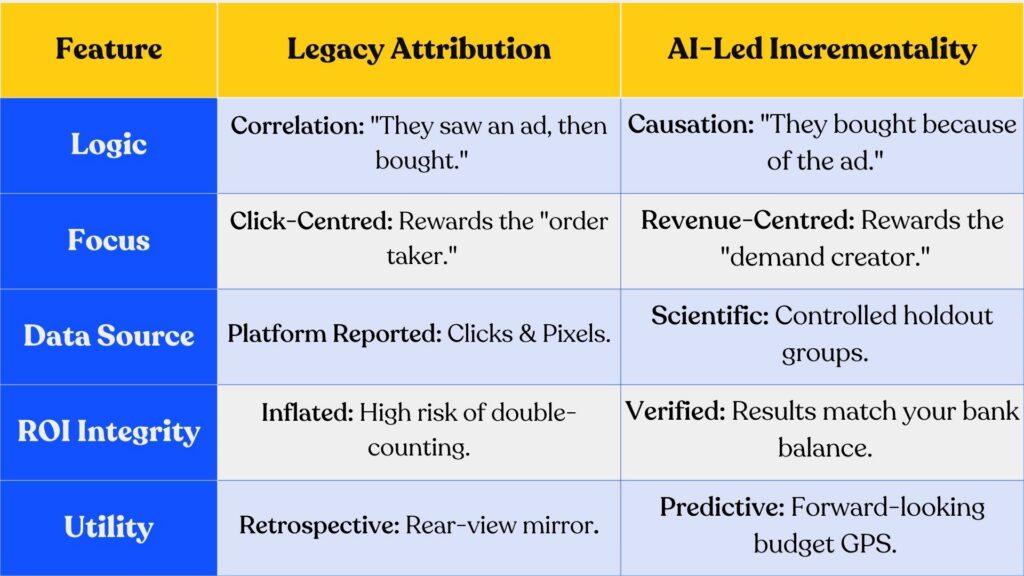
The “Truth Crisis” exists because legacy tools measure proximity, while AI measures influence. To fix your reporting, you must understand the difference between tracking a click and proving a sale.
The following comparison highlights the shift from “Platform Data” (what Meta/Google want you to see) to “Causal Truth” (what actually happened):
What is AI and Predictive Analytics?
In simple terms, AI and Predictive Analytics is about using your historical data to take an educated guess at what’s coming next. Instead of just looking in the rearview mirror at clicks that already happened, it uses machine learning to spot patterns in how your customers behave.
For Australian businesses, this is a game-changer because it helps you “fill in the blanks” when a customer journey goes dark, allowing you to predict which marketing moves will actually move the needle on your bottom line. This works best when paired with a solid CRO (Conversion Rate Optimisation) strategy to ensure your predicted traffic actually converts.
AI Powered Predictive Analytics is essentially the engine that makes this modelling work. Instead of needing a direct “click-to-sale” link for every single transaction, this technology looks at the bigger picture, analysing browsing patterns, market signals, and historical data to figure out which touchpoints are actually driving your revenue.
When you integrate this with AI SEO, you can stop guessing what happened in the “dark” parts of the funnel and start making decisions based on the most likely path your customers took to find you.
How AI driven analytics tools transform your data:
- Real-Time Anomaly Detection: Systems automatically flag performance shifts, such as budget pacing issues or sudden channel fatigue, allowing for proactive adjustments before they impact the bottom line.
- Predictive Lead Scoring: AI moves beyond static points to analyse vast data streams, including enrichment data and engagement signals, to identify what truly differentiates high-quality leads. This enables sales and marketing teams to prioritise outreach and invest resources where the highest impact is statistically most likely.
The Power of AI For Reporting And Analytics
Using AI For Reporting And Analytics is what finally lets Australian SMEs move away from the “grunt work” of manual data entry. Instead of spending hours cleaning up messy spreadsheets, these tools automatically scan your data for anomalies and trends that a human eye would likely miss.
It transforms your reporting from a static scoreboard into an active strategy tool, flagging when a campaign is fatiguing or where a new audience segment is starting to show real promise all in real-time.
Deploying AI Agents for Analytics
AI agents for analytics serve as an autonomous “sense-making” layer that can reason, interrogate data, and execute complex workflows across your entire marketing stack. These agents connect disparate tools from your CRM to Social Accounts to provide a multi-channel analysis of performance without manual intervention.
Task-specific agents now handle everything from market research to real-time budget reallocation, acting as a bridge between siloed platforms. They represent intelligent systems that can adapt and make complex decisions independently.
Teams integrating best AI analytics tools with agentic workflows report significant increases in lead conversion rates by automating repetitive manual reporting and identifying emerging audience segments.
The role of "Agentic" measurement:
- Share of Model (SOM): A new 2026 KPI that measures how often large language models (LLMs) like ChatGPT or Perplexity recommend your brand as a trusted authority within a specific category.
- Autonomous Optimisation: Agents don’t just report; they can proactively shift spend from underperforming channels to those with higher predicted returns in real-time through continuous trial-and-error learning.
Can AI-driven MMM work for SMEs?
Yes. Historically, Marketing Mix Modelling (MMM) was the “Rolls Royce” of measurement; it cost six figures and required a team of PhDs to run. However, in 2026, AI for Reporting And Analytics has democratised this technology for Australian SMEs.
By using AI Powered Predictive Analytics, smaller teams can now run directional “decision-support” models without needing decades of historical data. These modern models use Bayesian Logic to combine your past campaign experience with current market signals, giving you a high-leverage way to allocate your budget.
It allows an SME to see which channels provide the best “lift” and where to shift spend for maximum impact, all without the enterprise price tag.
Bayesian Logic for Smaller Australian Datasets
Bayesian logic is essentially a “common-sense” statistical method that combines what you already know (your prior experience) with new data to reach a smarter conclusion. It treats statistics as a “degree of belief” rather than an absolute, all-or-nothing certainty.
- How it Works: Instead of starting every analysis from zero, the model uses your “prior knowledge”, such as last year’s holiday performance or industry benchmarks, as a head start. As new data comes in, the AI “updates” its level of confidence, allowing it to predict outcomes accurately even when current traffic is sparse.
- Strategic Advantage: This enables SMEs to stay ahead by updating content and budgets early, before industry-wide trends become obvious, effectively turning limited data into a sustainable competitive moat.
How to Build an AI-Ready Stack Without "AI Theatre"
Building a legitimate AI-ready measurement stack requires prioritising data governance and a unified data model over simply adopting new software tools. To avoid “AI Theatre” where impressive dashboards mask poor data quality, organisations must focus on structured data architecture that generative engines can actually parse.
True AI readiness is achieved by creating a “truth layer” through first-party data that you own and control, rather than relying on rented third-party trackers. Most B2B marketers still write for traditional search, but AI search systems in 2026 reward authenticity and expert-led content that can be reliably cited.
Companies prioritising direct customer relationships and transparent data collection see higher engagement and better long-term customer value.
Why Australian Teams Need a Composable Strategy
Australian teams must adopt a composable strategy that balances innovation with strict local compliance standards, such as the Privacy Act 1988. A “privacy-first” framework is no longer just for compliance; it is a performance advantage that reduces operational risk and protects brand reputation.
The Best AI Analytics Tools for Your 2026 Stack
Finding “the truth” in your data starts with choosing the Best AI Analytics Tools to move beyond siloed spreadsheets and into a unified ecosystem. To avoid “AI Theatre” where impressive-looking dashboards mask poor data quality, your measurement stack should be built around these four essential layers:
1. The Foundation: Unified Data Warehouses
A centralised data warehouse is the “Single Source of Truth” (SSoT) where all your marketing, sales, and financial data live together.
- Google BigQuery: A serverless, Google-native platform that elastically scales to handle petabytes of marketing data without manual management.
- Snowflake: A flexible, multi-cloud solution that separates storage and compute, allowing you to scale your data analysis independently of your data storage.
2. The Engine: AI Driven Analytics & Modelling
These tools perform the heavy lifting of “probabilistic modelling,” filling in the gaps left by missing clicks and privacy regulations.
- Looker & Tableau: Advanced visualisation tools that use semantic modelling to ensure every department is looking at the same, verified metrics.
- Microsoft Power BI: Ideal for businesses in the Microsoft ecosystem, offering built-in AI-powered insights and predictive forecasting.
3. The Execution: AI Agents for Analytics
By 2026, autonomous agents will handle the tactical optimisation that used to take teams weeks to report.
- Salesforce Agentforce & Microsoft Copilot: These autonomous agents qualify leads, optimise campaign performance in real-time, and hand off to humans only when it is strategic.
- Madgicx: A specialised tool for e-commerce that uses AI agents to diagnose ad performance and provide 24/7 optimisation recommendations.
4. The Accuracy Layer: Identity & CRM Truth
To measure real business lift, you must connect your AI models to your actual revenue records rather than relying on anonymous website visits. This layer acts as the “reality check” for your ad spend, ensuring that what Google or Meta calls a “win” actually resulted in a paying customer in your bank account.
HubSpot CRM: These serve as the “reality check” for your ad spend, ensuring that what Google or Meta calls a “win” actually resulted in a customer.
Is Your Marketing Data Actually Growing Your Business?
At Sydney Digital Marketing (SDM), we don’t just “run ads”; we build the “truth layer” that connects your digital spend to your actual bank balance. In a world where platforms overclaim, and half the buyer journey is invisible, you need a partner who looks beyond the click to find the real source of your revenue.
We’ve helped ambitious Australian founders and their teams move from “hallucinated” ROI to forecastable, reliable growth through our proven Growth Engine Framework.
Whether you’re struggling with double-counting or want to unlock the power of HubSpot-driven AI and data analytics, we’re here to bridge the gap.
Why partner with SDM?
- HubSpot Specialists: We turn your CRM into a powerful feedback loop that cuts waste and identifies high-value clients.
- Measurement-First Approach: We run a Measurement Reality Check to surface blind spots and ensure your reporting is grounded in causal truth.
- Performance-Obsessed: We guide you to scale with total confidence, backed by real-time reporting and data-driven strategy.
Tired of “pretty reports” that don’t match your results? Let’s audit your current measurement stack and build a roadmap for 2026.

Article by
Simon Gould
CEO / Founder / Dad
Founder and leader, Simon established SDM back in 2012. Since then, he has helped 150 clients (and counting) to achieve their digital goals.[…]
